True wireless
Sealed buds in a pocket case, with hybrid ANC and two live connections.
True wireless audio · ANC · 40 h · IPX5
Seven pairs — true wireless, neckband, clip-on and calls — all built around the driver rather than the case. Hybrid noise cancellation to 38 dB, forty hours of playtime with the charging case, IPX5 across the range, and free worldwide shipping on every order. Three Bluetooth speakers sit beside them, on the same battery rule.
What we make
The driver, the noise-cancelling algorithm and the 40-hour battery target are shared across everything we make. What changes is where the thing sits.
Sealed buds in a pocket case, with hybrid ANC and two live connections.
Cord and necklace shapes that cannot be dropped down a drain, and hold a bigger cell.
Hooks that rest against the ear rather than sealing it. Nothing to work loose.
Single-ear headsets with mic arrays, sidetone and the charge level on the shell.
The second line. Same battery rule, IP67, and no noise cancelling because it would be pointless.
Single buds, replacement cases and all four tip sizes, for every product we have shipped.
The driver
Three driver platforms cover the whole range. Which one a model gets is decided by where it sits on your ear and how much air it has to move — not by what it costs.
Everyday true wireless
The workhorse. Titanium-coated dome for the top end, polyurethane surround for the bass it has to make in a sealed canal.
Neckband and clip-on
Stiff, light and efficient — it has to be loud on very little current, because an open-ear driver never gets a seal to help it.
Meridian
A dynamic driver for everything below 3.6 kHz and a balanced armature above it, so cymbals stop sharing a diaphragm with the bass.
The range
Every pair reaches at least forty hours of playtime and IPX5, because a spec that only the flagship meets is a spec you cannot put in a headline. Prices are in USD and include worldwide shipping, and each card carries that model’s own campaign poster. The three speakers are further down.
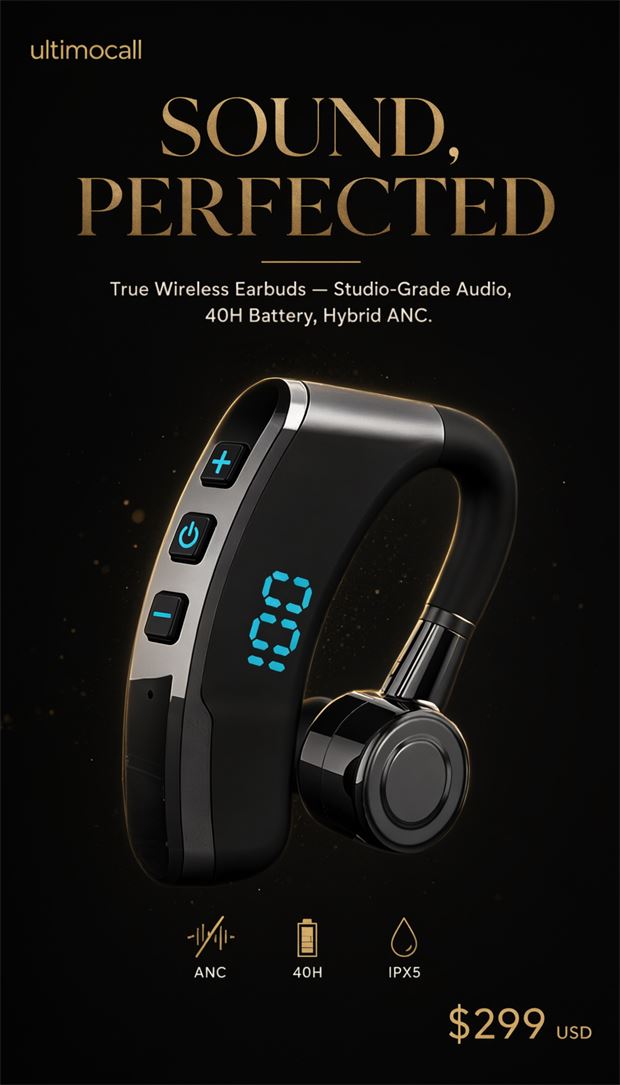
The single-ear hook headset, with the charge level printed on the shell so you know before the call, not during it. Hybrid ANC, six mics, 40 h.

The case is a football and the buds are panelled to match. None of which changes the 12 mm driver inside, or the 40 hours it runs for.
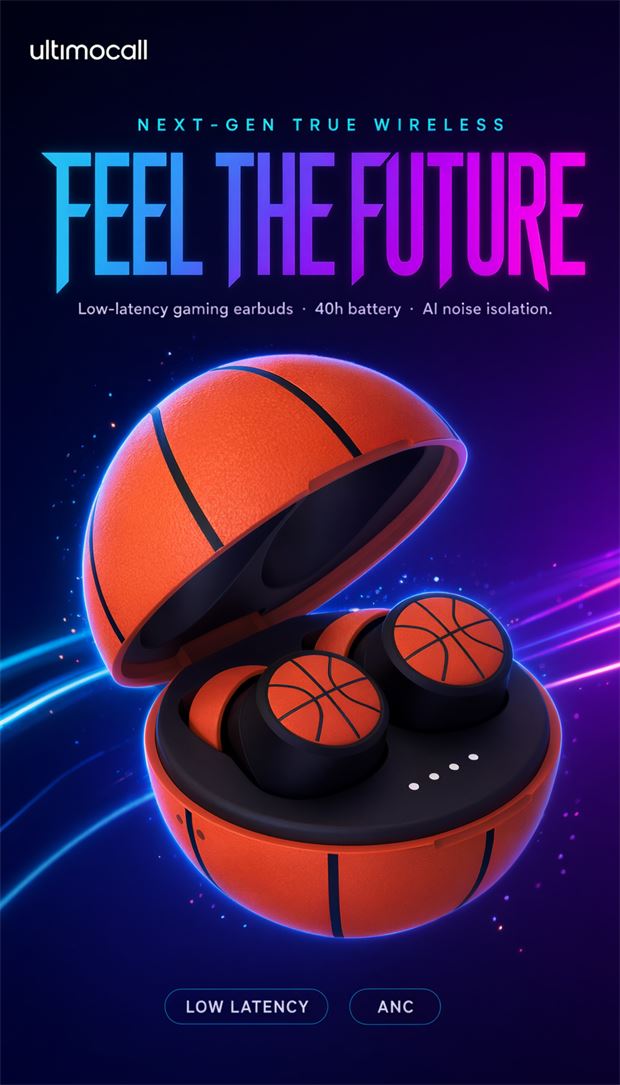
Wavelet’s driver, Wavelet’s battery, different firmware: a game mode that pulls end-to-end latency down to 55 ms and turns the ANC into a wind-tolerant filter.

The everyday pair, in Signal Red. 12 mm dynamic driver, hybrid ANC to 34 dB, eight hours in the buds and thirty-two in the case. The one most people should buy.
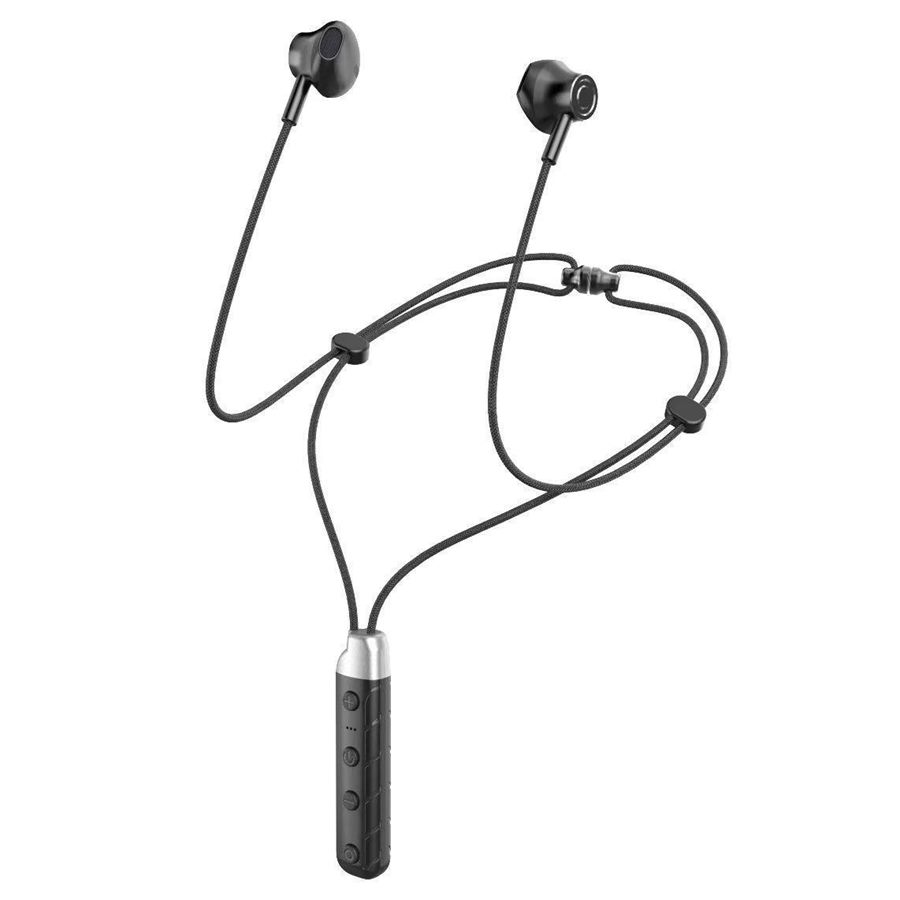
Braided cord, adjustable sliders, and every control on one inline pod — volume, power, calls, all under a thumb and none of them needing an app.
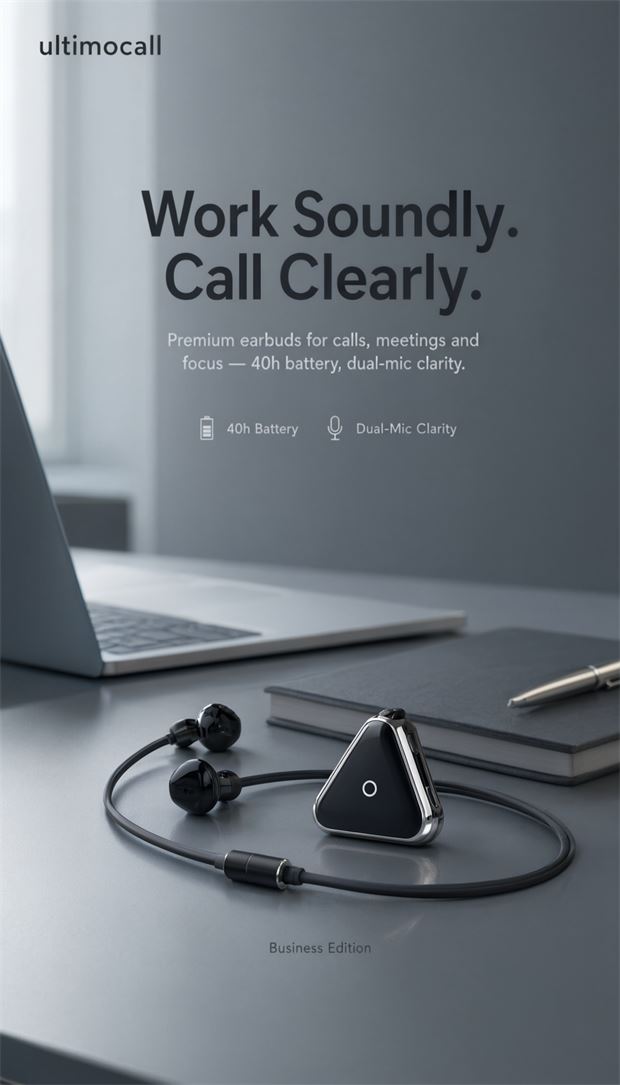
The electronics live in a triangular module that hangs where a pendant would, which is how a 40-hour cell fits on something this thin. Dual-mic with sidetone, in a Business and an Eco edition.
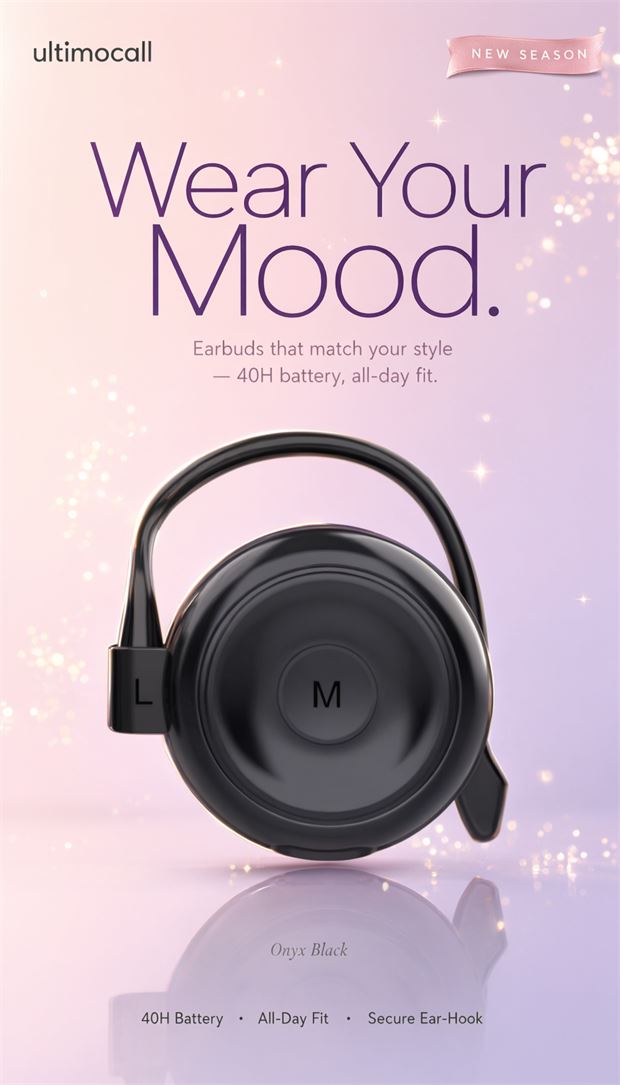
Clip-on hooks that sit against the ear instead of inside it, so nothing seals and nothing works loose. ANC, Bluetooth 5.4, 40 h. In Onyx Black.
Nothing in that family yet — email us and we will tell you what is coming.
The second line
Earbuds are what we do. The speakers exist because the driver work, the codec stack and the forty-hour battery rule were already paid for, and because people kept asking for something to put on a table. Three models is the whole line, and there is no fourth planned.
20 W from one 70 mm full-range driver and two passive radiators. Floats, 620 g, IP67. The one that lives in a bag.
360°, from an up-firing 80 mm driver into a dispersion cone with four radiators around the base. Stands in the middle of a table rather than at one end.
80 W of real stereo — two 90 mm woofers, two 20 mm tweeters, a steel handle and a strap. IP66 rather than IP67, because the handle mount is a hole.
How a pair gets made
Every bud is swept in a coupler and every pair is matched before it is boxed. It is the least glamorous part of the process and the reason two buds sound like one product. The speakers get steps 01, 02, 05, 07 and 08; the rest only matter to something that has to fit inside an ear.
Cavity volume, port length and nozzle diameter are simulated before any tooling is cut.
Dome, voice coil and magnet assembled, then matched into pairs to within ±1 dB.
Front and rear vents tuned so the seal does not turn into ear pressure on a long flight.
Each unit swept in a coupler; the feedback filter is written per unit, not per batch.
SBC and AAC everywhere, LC3 where the hardware supports it, dual connection on every model.
Checked on a head simulator across all four tip sizes, because ANC without a seal is decoration.
1.2 m drops onto oak, 48 hours of salt-fog sweat, then the IPX5 jet from every direction.
Buds paired to their case at the line and packed with all four tip sizes in the box.
Noise control
Four of the six microphones on a pair are doing noise cancellation: two outside listening to the world, two inside listening to what leaked past the tip. The outside pair handles steady low-frequency noise, the inside pair corrects for your particular ear.
Measured on Meridian with the medium tip on a head simulator. Your ear is not a head simulator; a tip that seals matters more than any of these numbers.
Battery & charging
Eight hours in the buds plus thirty-two in the case, at 50 % volume on AAC with noise cancelling off. Turn ANC on and it is about six and thirty. We publish both because the first number is the one everybody prints and the second is the one you will live with.
Fit, comfort, durability
None of them are on the spec sheet people compare. All of them are why a pair ends up in a drawer.
XS to L silicone, plus memory foam in medium. Fit decides bass response and it decides how much noise the ANC has to work on — shipping one tip size and calling it universal is the cheapest way to make a good driver sound wrong.
Weight is where the flagship pays for its second driver. Vox 1 is 4.6 g a bud, Meridian is 12 g on one ear, and the difference is noticeable after about three hours. Both distribute load onto the concha rather than hanging off the canal.
IPX5 is a 12.5 litre-per-minute jet from any angle for three minutes — sweat, rain, a rinse under the tap. It is not immersion. The three speakers are separately rated IP67 and survive 1 m for 30 minutes; nothing you wear here is a swimming earbud.
Optical, not capacitive, so a hat or a hood does not pause your music. Take a bud out and playback stops in under half a second; put it back and it resumes without reaching for the phone.
Quality & compliance
Radio equipment is regulated everywhere it lands. These are the tests a pair passes before it ships and the approvals that let it cross a border.
Every bud measured 20 Hz – 20 kHz against the model's reference curve; anything outside ±3 dB goes back.
Left and right matched to within ±1 dB across the band, then paired for life and boxed together.
1.2 m onto oak, ten faces, bud and case. The hinge and the nozzle are what break, so those get twenty.
48 hours of artificial perspiration at 35 °C. Sweat kills more earbuds than water does, and it kills them at the contacts.
An IPX5 jet at 12.5 l/min from every direction for three minutes on the wearables; the speakers add a 1 m, thirty-minute immersion for IP67. Full electrical and acoustic retest after either.
500 full charge cycles at 25 °C, with capacity logged; the pass mark is 80 % of rated capacity.
Shipping, warranty, returns
Every order ships free and tracked, wherever you are, with no minimum. What we cannot absorb is import duty and local sales tax — those are charged by your customs authority, not by us, and they are the one cost we will never be able to quote in advance.
Questions
Talk to us
One working day, and a person who knows the difference between the models — not a queue number.